

A pelvic exam and a Pap smear are often mentioned together, but they’re not quite the same thing. If you have ever left an appointment unsure of which test you had, you are not alone.
While both are part of routine gynaecological care, they serve different purposes. Understanding how they differ and when each is needed can help you feel more prepared and confident at your next visit.
What is a pelvic exam?
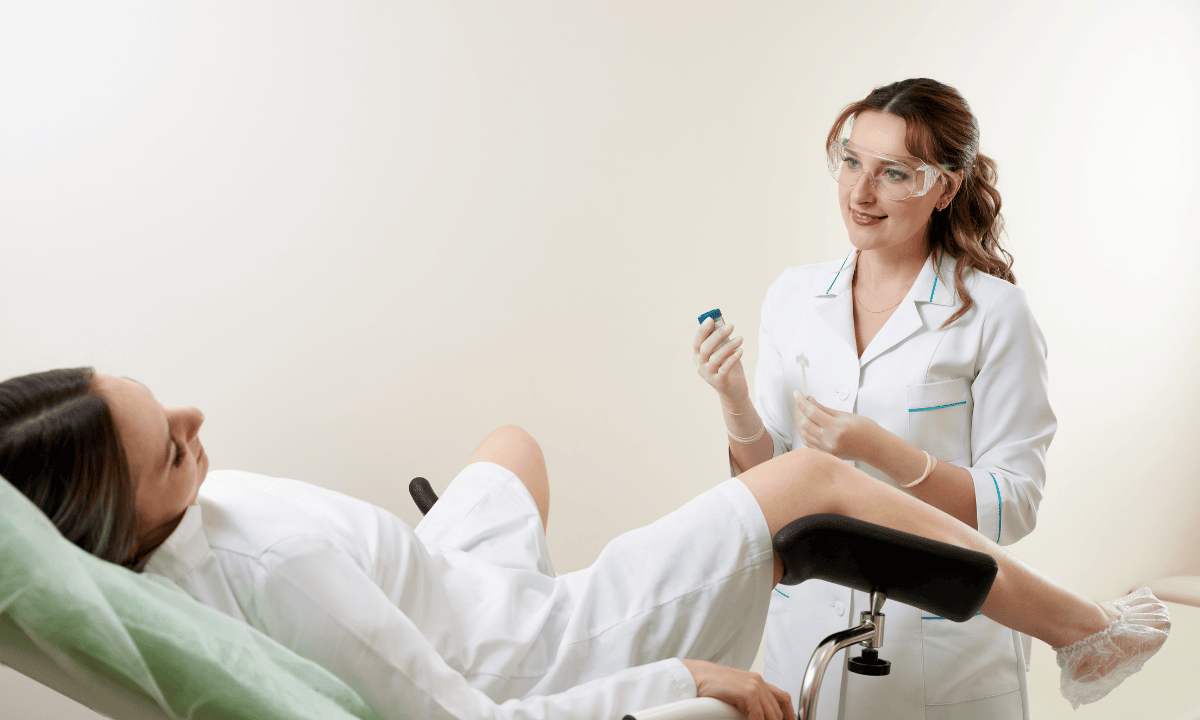
A pelvic exam is a routine physical assessment of your reproductive organs. Think of it as a general health check, focused entirely on your reproductive system.
During the exam, your doctor will assess:
Vulva (the external genital area)
Vagina and cervix
Uterus and ovaries
Fallopian tubes
It can help detect conditions early, including:
Infections such as bacterial vaginosis or sexually transmitted infections (STIs)
Signs of pelvic inflammatory disease (PID)
Structural changes that may affect fertility or pelvic health
The exam is performed by a gynaecologist or trained doctor. You may feel a little pressure at most – it is generally a straightforward and short procedure.
What to expect during a pelvic exam
A pelvic exam usually takes around 5 to 10 minutes. You'll lie on an examination table with your knees bent, and a drape will be provided for your privacy.
The exam usually has three parts:
External exam:
Your doctor will visually check the vulva for any signs of irritation, redness, or abnormalities.
Speculum exam:
A small, smooth instrument called a speculum is gently inserted into the vagina. This allows your doctor to see the vaginal walls and cervix clearly.
You may feel a little pressure. If anything feels uncomfortable, let your doctor know.
Bimanual exam:
Your doctor will insert two gloved fingers into the vagina while gently pressing on your lower abdomen.
This helps them feel the size, shape, and position of your uterus and ovaries.
It's completely normal to feel a little nervous beforehand. Many women find it more straightforward than they expected.
If you've been putting off your first gynaecological check-up because you're unsure what to expect, schedule an appointment with Thomson Medical. Our doctors can walk you through the process and address any concerns before the exam begins.
What is a Pap smear test?

A Pap smear, also called a cervical smear or Pap test, is a specific screening test for cervical cancer. Unlike a pelvic exam, it focuses specifically on collecting cells from the cervix.
Abnormal cells don't always mean cancer. In many cases, they are precancerous, meaning they can be monitored or treated before anything more serious develops. Catching changes early gives you a better chance of managing them, which is why routine screening is worthwhile.
What to expect during a Pap smear
The procedure is usually under five minutes.
You'll lie on an examination table in the same position as for a pelvic exam. Your doctor will gently insert a speculum to open the vaginal walls, then use a small, soft brush to collect cells from the surface of your cervix. The sample is sent to a laboratory for analysis.
You may feel brief pressure or a light scratching sensation, which settles quickly. Some women also notice mild spotting afterwards, which usually resolves on its own.
Results are usually ready within a few weeks. Your doctor will walk you through what they mean and whether any follow-up is needed.
Pelvic exam vs Pap smear test: What are the key differences?
While both are part of routine gynaecological care and are often done at the same appointment, a pelvic exam and a Pap smear are two distinct procedures with different purposes.
Here's a simple breakdown:
Pelvic exam | Pap smear | |
Purpose | Overall reproductive health check | Cervical cancer screening |
What it assesses | Uterus, ovaries, cervix, vagina, vulva | Cervical cells only |
Cell collection involved? | No | Yes |
Detects | Infections, cysts, fibroids, structural changes | Abnormal or precancerous cervical cells |
Often combined with | Pap smear, if due | HPV test (co-testing optional) |
Who it's for | All women | Women aged 25 to 69 (Singapore guidelines) |
The two tests complement each other but are not interchangeable, and having one does not mean you've had the other. Your doctor will advise which is appropriate for your situation at each visit.
Do you need a Pap smear, a pelvic exam, or both?
Whether you need a Pap test, a pelvic exam, or both depends on your age, symptoms, and when you last had each test.
Your situation will determine which is more suitable or whether both are needed at the same visit:
You've never had a gynaecological check-up:
A pelvic exam is a good starting point.
If you're 25 or above, your doctor will likely recommend a Pap smear at the same visit.
You're experiencing symptoms, such as unusual discharge, pelvic pain, or irregular bleeding:
A pelvic exam is the more appropriate first step, as it can help identify the underlying cause.
You're due for routine cervical screening:
A Pap smear is what you need, often combined with an HPV co-test depending on your age.
You're pregnant:
Pelvic exams are a standard part of prenatal care.
If your Pap smear is overdue, your doctor may recommend doing one early in your pregnancy.
You've had a total hysterectomy (including removal of the cervix):
Routine Pap smears are generally no longer needed.
However, if your hysterectomy was related to cervical cancer or abnormal cells, some follow-up screening may still be recommended.
That said, you don't need to figure this out on your own. If you're unsure, discuss with your doctor to confirm what's due and address them in a single visit.
If you're not sure where to start, schedule an appointment with Thomson Medical. Our doctors can assess your needs and recommend the right tests for you.
How often should you get a pelvic exam or Pap smear?
The two tests follow different schedules. One is guided by national screening guidelines, the other by your individual health needs. Understanding which applies to you, and when, makes it easier to plan your care with confidence.
How often should you get a Pap smear?
In Singapore, the Ministry of Health (MOH) recommends the following screening frequency based on your age:
If you are aged 25 to 29, a Pap smear is recommended every 3 years.
If you are aged 30 to 69, an HPV test is recommended every 5 years. Your doctor may recommend combining this with a Pap smear depending on your health history.
The guidelines above apply to women with no previous abnormal results. If your last screening flagged anything unusual, you may need to be screened more frequently – your doctor will advise on the appropriate interval.
How often should you get a pelvic exam?
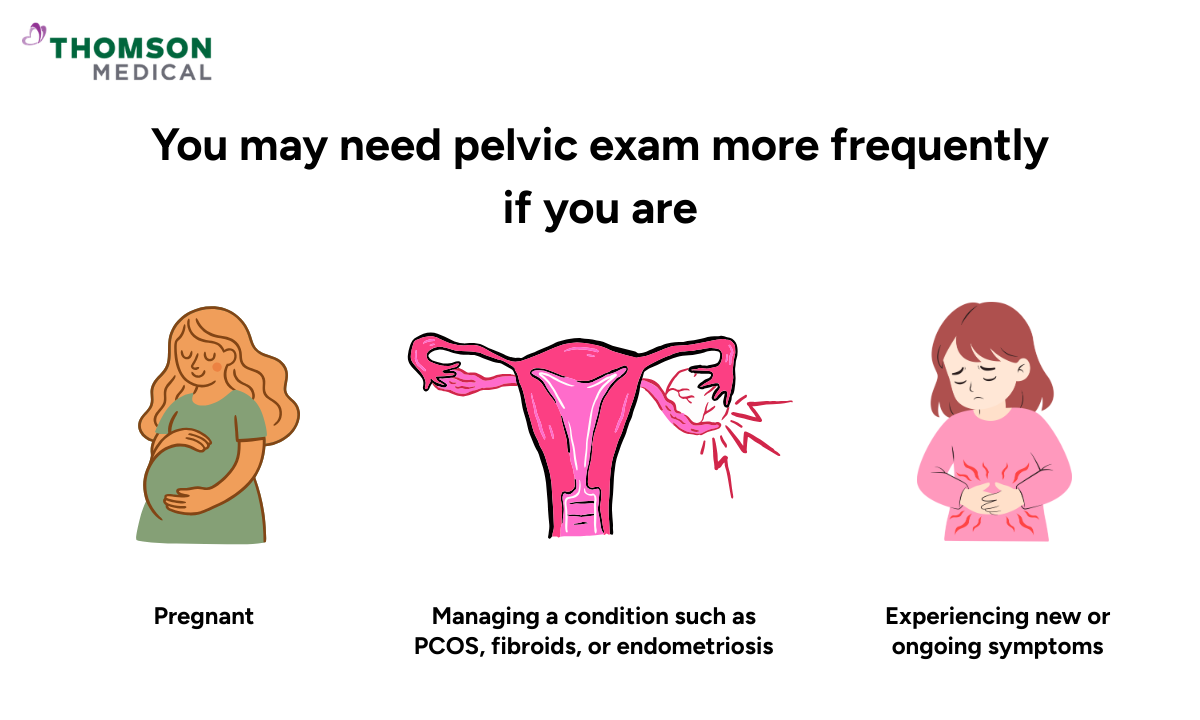
Unlike a Pap smear, there is no fixed universal schedule for pelvic exams. As a general guide, an annual exam is reasonable for most women as part of routine gynaecological care.
You may need them more frequently if you are:
Pregnant
Managing a condition such as polycystic ovary syndrome (PCOS), fibroids, or endometriosis
Experiencing new or ongoing symptoms
The right frequency will vary from person to person. What matters most is that these checks remain a consistent part of your healthcare routine.
Both a pelvic exam and a Pap smear are small but meaningful ways of looking after yourself. Neither takes long, and both can catch things early when they're most manageable. If it's been a while since your last check, it may be time to book one in.
Gynaecologists at Thomson Medical
Loading...
FAQ
Are a Pap smear and a pelvic exam the same thing?
No. A pelvic exam is a physical assessment of your reproductive organs. A Pap smear is a specific test that collects cervical cells to screen for abnormal changes. They are often done at the same appointment, but they serve different purposes.
Can you do a Pap test at home?
Self-collection HPV tests are available in some countries, but a standard Pap smear still requires a clinician to collect cells directly from the cervix. If you're unsure what's available to you, it's worth checking with your gynaecologist.
Can you get a Pap smear and pelvic exam at the same time?
Yes, and this is common. Many gynaecologists will perform both during a single visit, which is convenient if both are due.
Can you get a pelvic exam without a Pap smear?
Yes. A pelvic exam can be done on its own, particularly if you have symptoms to investigate or are not yet due for cervical screening.
At what age should you get a Pap smear?
In Singapore, cervical screening is recommended from age 25. Before that, a pelvic exam may still be appropriate if you have symptoms or concerns.
Can you have a pelvic exam if you're a virgin?
Yes. Your doctor will take your circumstances into account and can adjust the examination accordingly. If you have any concerns beforehand, it's worth mentioning them before the exam begins.
The information is intended for general guidance only and should not be considered medical advice. For personalised recommendations and advice based on your unique situation, please consult a specialist at Thomson Medical. Request an appointment with Thomson Medical today.
Citations
Awareness of need for cervical cancer checks. (n.d.-b). Ministry of Health. https://www.moh.gov.sg/newsroom/awareness-of-need-for-cervical-cancer-checks/
For more information, contact us:
Thomson Specialists (Women's Health)
Thomson Women's Clinic (TWC)
- Novena:
6592 6686 (Call), 8611 8986 (WA) - Bukit Batok:
6569 0668 (Call), 8686 3525 (WA) - Choa Chu Kang:
6893 1227 (Call), 8282 1796 (WA) - Jurong:
6262 8588 (Call), 6262 8588 (WA) - Katong (female doctor):
6970 2272 (Call), 8611 9020 (WA) - Punggol:
6243 6843 (Call), 8811 0328 (WA) - Sembawang: 6753 5228
- Sengkang: 6388 8125
- Serangoon (female doctor): 6382 3313
- Tampines: 6857 6266
- Tiong Bahru: 6276 1525
Notice
The range of services may vary between TWC/TS locations. Please contact your preferred branch directly to enquire about the current availability.
Request an Appointment